
Concrete Block Making Solution with Cement and Sand
If cement, sand and stone are easy to obtain in your area, you already have the main materials needed to produce concrete blocks. After these materials are mixed with water, they become the concrete mixture supplied to the block machine.
With a suitable FUREIN cement block making machine and mold, you can produce hollow blocks, solid blocks, concrete bricks, interlocking blocks, pavers and other confirmed concrete products. Tell us which product sells well in your market. We will help you check the mix, mold, machine and production-line configuration.
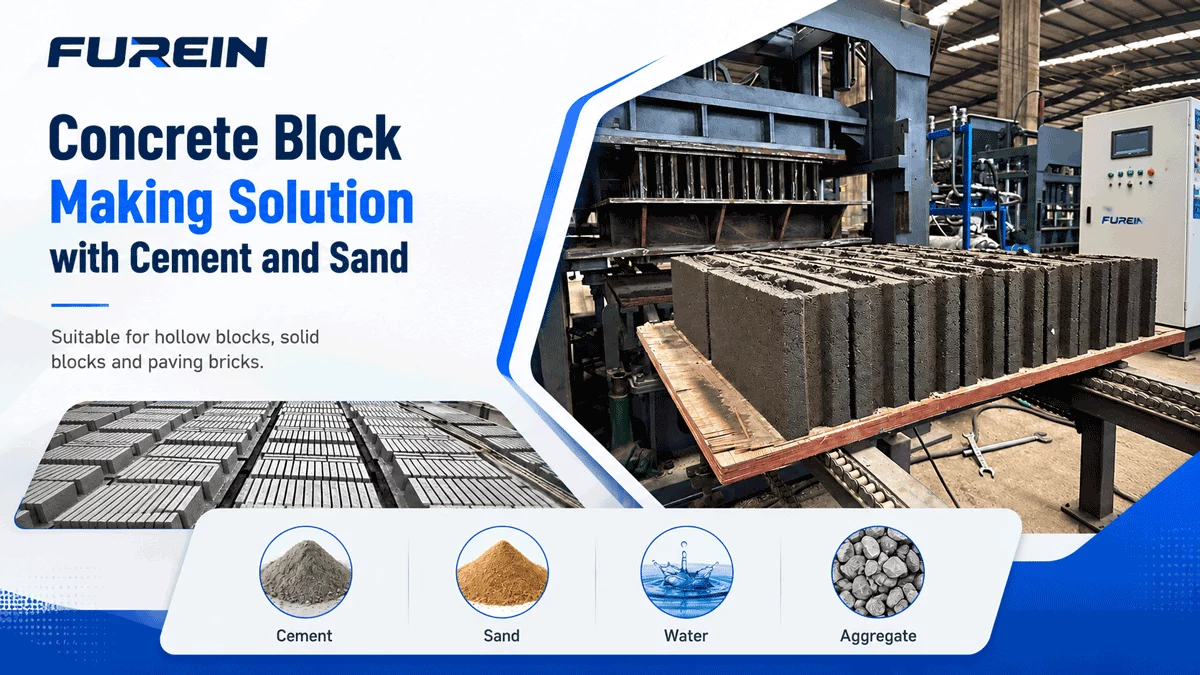
What Can You Make with Cement, Sand and Stone?
Your local market should decide what you produce. If hollow blocks are used for most wall projects in your area, start with the popular hollow-block sizes. If contractors mainly buy solid bricks or pavers, the mold and production plan should follow that demand. There is no advantage in buying a large block machine to produce a block that is difficult to sell.
The main raw materials are simple:
- Cement: binds the sand and stone together.
- Sand:fills the smaller spaces in the mixture and affects the surface and water demand.
- Stone, crushed aggregate or stone dust: helps form the main structure of many concrete blocks.
- Water: allows the materials to mix, compact and develop strength.
- Optional functional materials: such as fibers, pigments, water-reducing admixtures or early-strength admixtures may be used when your product and local standard require them. Their suitability and dosage must be confirmed through the mix design and supplier instructions.
These materials can be used for several products:
- Hollow concrete blocks: External walls, internal walls or partitions, depending on the local standard.
- Solid concrete blocks or cement bricks: Walls, foundations or other locally accepted masonry work
- Interlocking blocks: Dry-stacked walls or other local building systems
- Concrete pavers: Yards, walkways, parking areas or other approved paving work
- Kerbstones and special products: Roadside, landscaping or project-specific use
Do not assume that every product only needs a different mold. A paver may need finer face material and a face-mix unit. A thin-wall hollow block needs stable feeding into narrow mold spaces. A large solid block is heavier after demolding and may need a different transfer method.
Common block sizes customers ask about
The dimensions below are examples often seen in the market, not universal standards. Your actual mold must follow the dimensions used by local builders and block buyers.
- Hollow block: 400 × 200 × 200 mm, 400 × 150 × 200 mm, 400 × 100 × 200 mm
- Solid concrete brick: 230 × 110 × 75 mm or another local brick size
- Rectangular paver: 200 × 100 × 60 mm or 200 × 100 × 80 mm
- Interlocking block: No single standard shape
- Kerbstone: Project and country dependent
The words “block” and “brick” are also used differently from one market to another. You do not need to decide which English name is correct. Send us a photo, sample or drawing, and we will confirm the mold according to the actual product.
FUREIN Concrete Block Machine and Line Configuration
You do not need to decide whether you want a manual, semi-automatic or fully automatic line before contacting us. First tell us how your cement and aggregates arrive, which blocks you want to produce and how you plan to move fresh blocks. We can then connect the required equipment into a production line that suits your factory.
A normal cement and sand concrete block production line follows this process:
Sand and stone storage → aggregate batching → cement and water feeding → mixing → material conveying → block forming → fresh-block transfer → curing → stacking
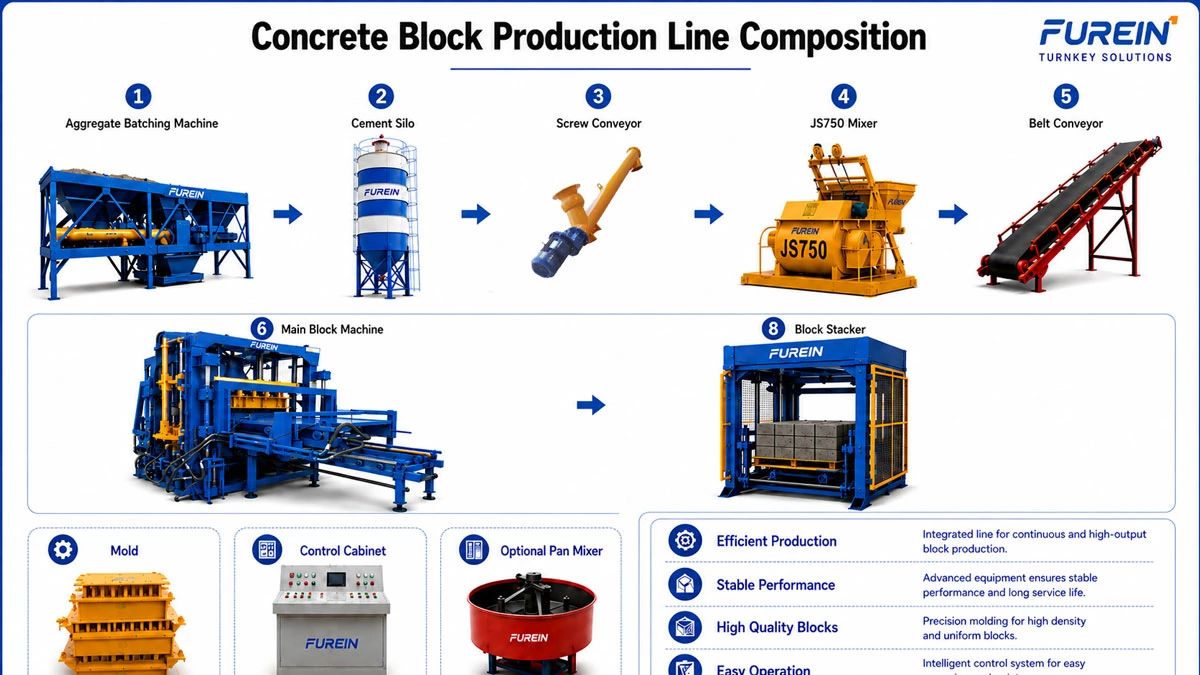
The concrete block machine is the center of the line, but the equipment before and after it determines whether production can continue smoothly.
If your cement arrives in bags, workers can feed it into the mixer or a weighing hopper. You may not need a cement silo at the beginning. If bulk cement is available and your daily consumption is high, we can add a cement silo, screw conveyor and cement weighing system. This reduces manual bag handling and makes cement feeding easier to control.
For sand and stone, the concrete block making configuration depends on how many materials you use. A small factory using one simple aggregate mix may load the mixer directly. If you need to combine sand, stone dust and different aggregate sizes, an aggregate batcher can measure each material before mixing. This gives you better control than asking workers to estimate every batch by eye.
The mixer must be matched to the brick making machine. It should prepare enough material for the next forming cycle without keeping the machine waiting. If you already have a mixer, send us its usable batch volume, mixing time and discharge height. We will check whether it can be connected to the proposed conveyor and block machine.
After mixing, a belt conveyor normally sends the concrete mixture to the machine hopper. The feeding system distributes the material into the mold, and the machine forms the blocks through the confirmed vibration and hydraulic process. By changing the approved mold, the same machine may produce hollow blocks, solid blocks, concrete bricks or pavers.
If you plan to produce colored paving blocks, tell us before the line is finalized. A paver with a colored surface may need a separate face-mix unit and a second mixer. This equipment is normally unnecessary when you only produce ordinary hollow or solid blocks.
What kind of concrete block-making solution do i need?
You do not need to purchase every available machine. For your project, FUREIN will separate the equipment into three groups:
- concrete block making equipment required for normal production;
-concrete block making machine that can reuse what you already have;
- optional equipment that reduces labor or supports future expansion.
Send us your block drawing, raw-material photos, expected daily output, local voltage and site dimensions. We can then prepare the concrete block making machine list and CAD layout showing where the batcher, mixer, block machine, pallet route and curing area should be placed.
Frequently Asked Questions
Can FUREIN block machines make hollow blocks, solid blocks and pavers?
Yes. A suitable FUREIN machine can produce different confirmed concrete products by using the correct mold and production configuration. Send us the product drawing because pavers, hollow blocks and large solid blocks may need different feeding and handling equipment.
What materials are needed to make concrete blocks?
The main raw materials are cement, sand, stone or another suitable aggregate and water. Fibers, pigments, early-strength admixtures or other functional materials may be added when the product standard and mix trial support their use.
What is the correct concrete block mix ratio?
There is no universal ratio for every factory. The formula depends on your cement, sand grading, aggregate size, material moisture, required block strength and curing method.
Can a concrete block machine produce the block size used in my country?
In most cases, a suitable mold can be designed after the product and machine are confirmed. Send the exact length, width, height, cavity, wall thickness and required strength. FUREIN will check the mold layout and machine limits before confirming capacity.