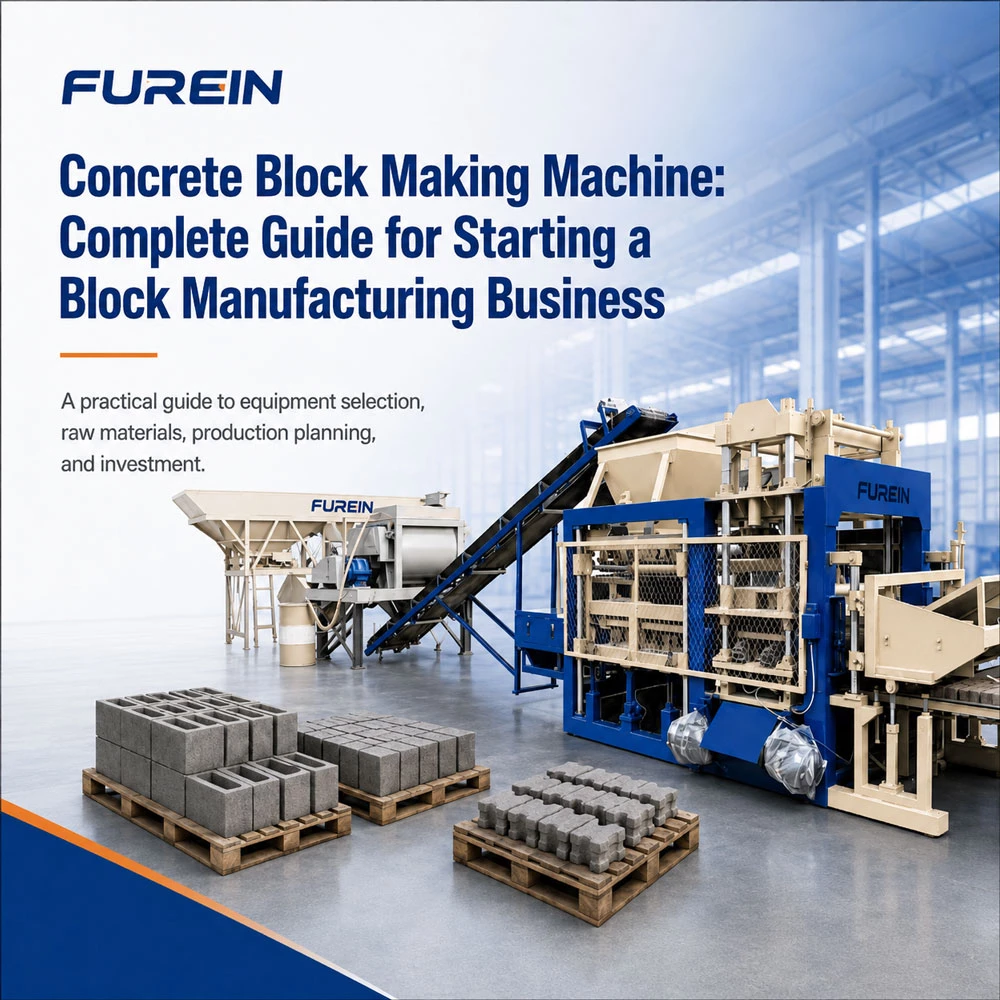
When customers ask us for a complete concrete block production line, one of the first things I usually explain is that there is no fixed equipment list that every factory must follow.
A concrete block production line is actually quite flexible.
You can start with only the concrete block machine and keep the investment low. You can also add batching, weighing, conveying, pallet handling and stacking equipment if you want more automation.
This is why we normally treat a concrete block production line as a group of modules instead of one fixed package.
The right configuration of complete block making production line mainly depends on three things: how many blocks you want to produce, how much labor you want to use, and how much you want to invest at the beginning.
For a new block factory, you do not have to buy everything on the first day.
Start From A Concrete Block Machine
The concrete block making machine is the center of the production line. Everything else is added around it.
For a small factory, the production process can be very simple.
Raw materials are mixed, the mixed material is fed into the block machine, the blocks are formed, and workers move the fresh blocks to the curing area.
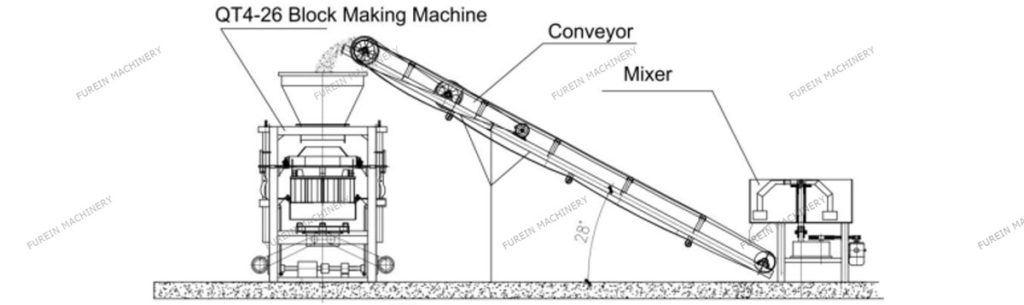
For a larger factory, exactly the same process can be done with automatic batching, automatic weighing, belt conveyors, automatic pallet feeding and stacking equipment.
The basic production principle does not change. What changes is how much work is done by people and how much is done by machines.
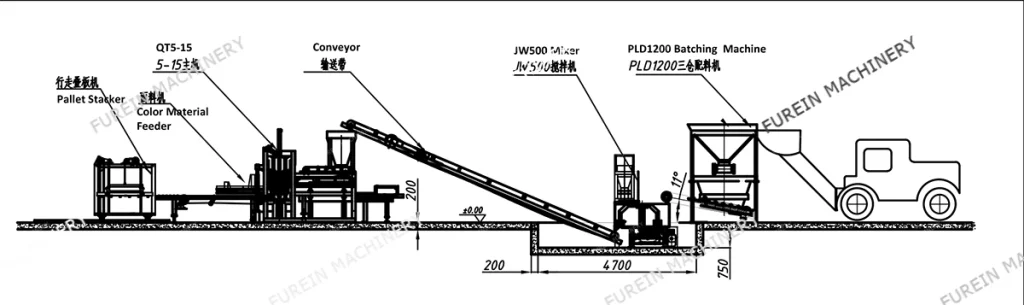
This is also why two customers buying the same block machine may finally have very different production line configurations.
QT4-40 Can Start With a Very Simple Configuration
Take the QT4-40 block machine as an example.
If a customer is just starting a concrete block business and wants to control the initial investment, there is no need to build a complicated complete block machine production line.
A practical starting configuration can simply be: JW350 mixer + QT4-40 block machine + mold + trolley.
The JW350 pan mixer has a 350 L mixing capacity per batch. After mixing, workers can manually move the material to the small concrete block machine. The blocks are formed on the QT4-40 and then moved away by trolley. That is already enough to start producing blocks.
You do not need an aggregate batching machine. You do not need a cement silo. You do not need an automatic weighing system. You do not need a complicated conveyor system. For a small business, sometimes simple equipment is actually easier to manage.
The important point is that this is only one possible configuration. If your business grows later, you can add more equipment instead of replacing the whole production line.
When to Upgrade Your Small Concrete Block Production Line?
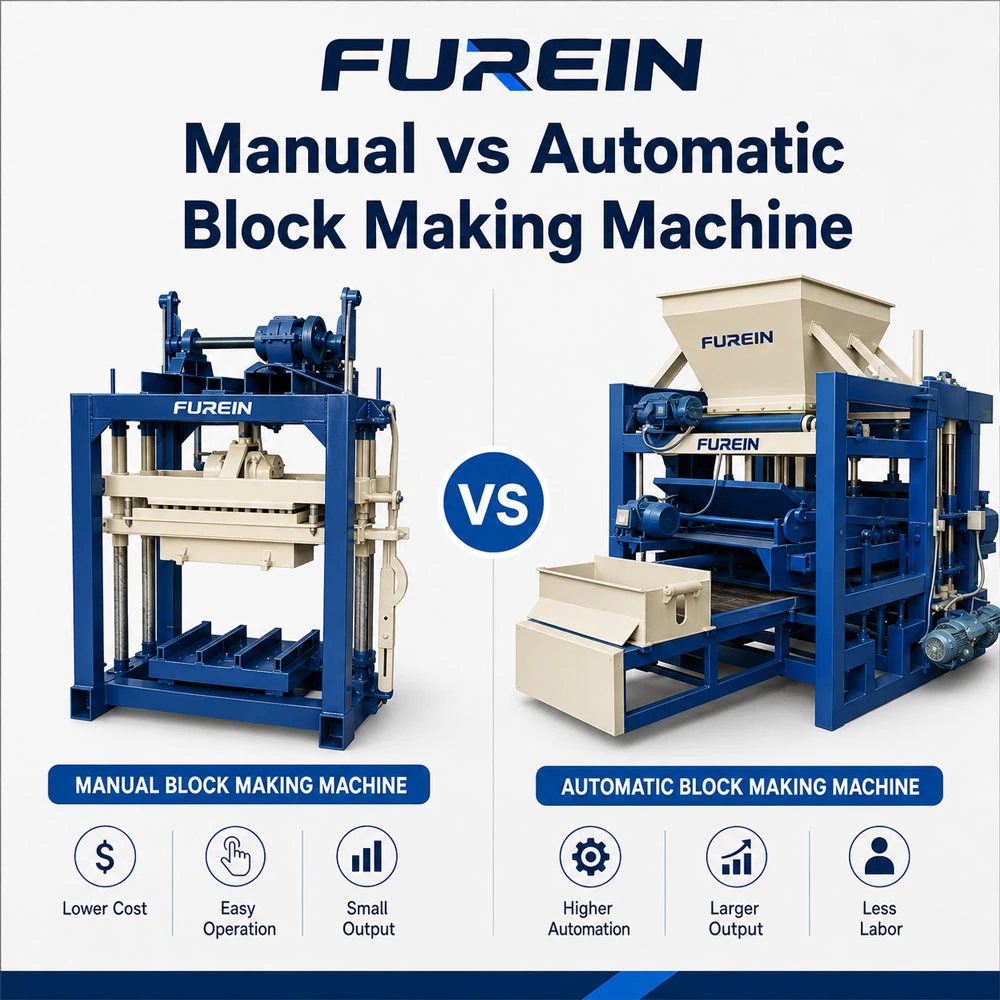
When block production demand increases, the first problem customers normally meet is not that the maual concrete block production line is too slow. It is that workers cannot keep up.
One worker is mixing materials. Another worker is feeding the machine. Several workers are moving pallets and fresh blocks. When one position slows down, the entire concrete block making plant slows down. This is where additional equipment starts to make sense.
For a semi automatic block production line, Furein Block normally keeps the basic block machine but improves material preparation and material handling.
How to upgrade your concrete block machine?
For example, instead of manually measuring sand and stone every batch, an aggregate batching machine can be added.
Instead of manually carrying mixed material to the block machine, a belt conveyor can be added.
Instead of workers moving every pallet by hand, pallet handling equipment can be added.
The concrete block machine itself may still require operators, but the heavy and repetitive work is reduced.
This is usually a good choice for customers who have stable sales but are not yet ready to invest in a fully automatic concrete block production line. There is no need to pursue automation just for the sake of automation.
An Automatic Block Production Line Can Be Configured Around Your Budget
Many customers ask us for a complete automatic block production line, but in fact there is no single standard configuration for every project.
A concrete block production line is a combination of different modules. The automatic block making machine is the core equipment, while the batching system, mixer, conveyor, pallet handling and stacking system can be selected according to the customer's production requirements, labor cost and investment budget.
This modular block production line design gives customers more flexibility. A new investor can start with a basic block making machine and add more automation equipment after the business grows. A large block factory can directly choose a complete automatic concrete block production line to reduce labor and improve production stability.
The purpose is not to buy the most equipment, but to choose a configuration that matches the actual market demand.
For customers who want to control the initial investment, the flexible block making machine setup can start with a simple configuration: Concrete Mixer + Belt Conveyor + Automatic Block Making Machine + Mold + Pallets.
Taking the QT6-15 automatic block machine as an example, the main machine already includes the material feeding system, pallet feeding system, block conveyor, hydraulic station and automatic control cabinet.
With this configuration, the customer can prepare raw materials manually, mix the concrete and supply the material to the block machine. It is suitable for markets where labor cost is acceptable and customers want to enter the block manufacturing business with controlled investment.
When production capacity increases, manual preparation of sand and stone becomes more difficult to manage. At this stage, customers usually add an aggregate batching system.
The production process changes from manual preparation to:
Raw Material Storage → Automatic Batching → Mixing → Block Forming
For example, the QT6-15 production line can be equipped with a PLD1200 aggregate batcher. The system uses storage hoppers and a weighing hopper to measure raw materials before they enter the mixer.
Building a Higher Automation Block Production Line
For customers who want a higher level of automation, more modules can be added. The front-end system can include a cement silo, screw conveyor, cement weighing system and water weighing system. The QT6-15 block machine configuration can be equipped with these components to achieve more automatic material feeding and weighing.
The complete production process becomes: Aggregate Batching → Cement and Water Weighing → Mixing → Conveying → Automatic Block Making.
This type of automatic concrete block production line is suitable for customers who have stable orders and want continuous production with fewer workers.
Reducing Labor Through Automatic Pallet Handling
Many customers focus only on the block machine but ignore pallet handling. In actual production, every block cycle needs an empty pallet, and fresh blocks need to be moved to the curing area. When production increases, manual pallet handling may become the bottleneck.
Therefore, the production line can be expanded with an automatic pallet feeder, pallet conveyor and pallet stacker.
The QT6-15 block making machine solution can include automatic pallet handling equipment to reduce manual operation and improve production efficiency.
Choose the Right Block Production Line Configuration for Your Business
A successful block factory does not always start with the most expensive equipment.
The right production line is the one that matches your current market demand, production target and investment plan, while leaving enough space for future expansion.
Some customers may only need a simple block machine and mixer to start production. Others may require a complete automatic block production line with batching, weighing, material handling and stacking systems.
There is no universal configuration that fits every project. Before recommending a solution, we usually need to understand your actual situation, including:
- What type and size of blocks do you want to produce?
- How many blocks do you plan to produce per day?
- What raw materials are available in your area?
- How much factory space do you have?
- What level of automation are you looking for?
Based on these details, we can help you choose a suitable concrete block production line configuration, from a basic setup to a fully automatic block manufacturing system.
If you are planning to start a block factory or upgrade your existing production line, feel free to contact Furein Block. Send us your block size, expected capacity and investment budget. FUREIN team will help you design a practical block production solution that fits your business.